


IFOY Schirmherrschaft

IFOY Träger


IFOY Partner


LocusONE bei The Quality Group
Locus Robotics


IFOY-Kategorie
Integrated Customer Solution
Zusammenfassung
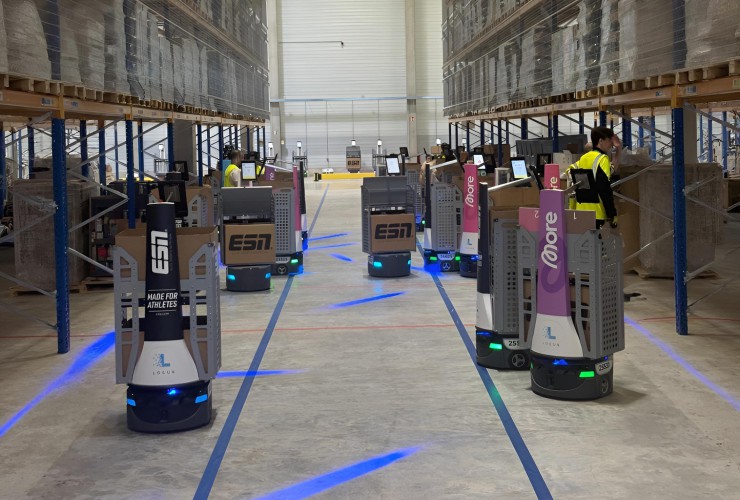
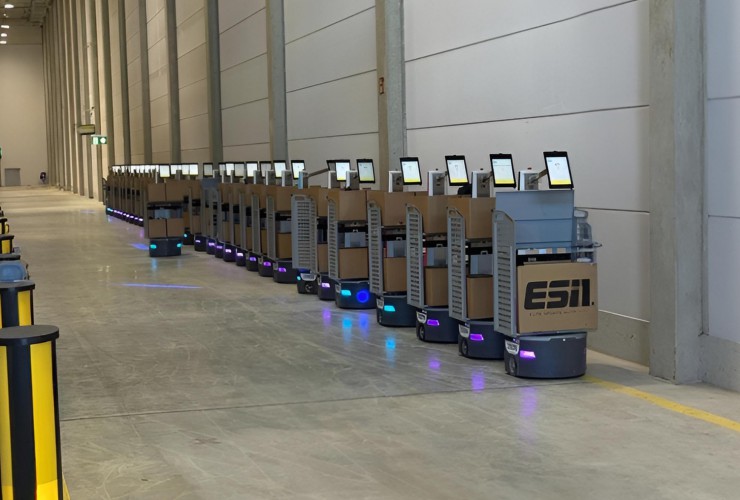
Vom Greenfield-Start zum Peak-Ready-Betrieb in acht Monaten: LocusONE orchestriert bis zu 350 Locus Origin AMRs im 40.000 m² großen Fulfillment-Center der Quality Group in Elsdorf. Für die stark wachsenden Marken ESN und More Nutrition, deren influencer-getriebene Kampagnen jede SKU über Nacht zum Topseller machen können, reagiert die LocusONE-Plattform sofort. Aufgaben und Roboter werden in Echtzeit entlang der Nachfrage neu verteilt, sodass der Durchsatz unabhängig davon hoch bleibt, für welche Produkte gerade die Nachfrage explodiert. Die Operation skalierte in nur acht Monaten von 40 auf 350 Roboter und zeigt, dass flexible, software-definierte Automatisierung heute den Durchsatz fixer Systeme erreicht, ohne die Anpassungsfähigkeit zu verlieren, die moderne E-Commerce-Modelle brauchen.
Kunde
The Quality Group
Umsetzungszeitraum
Von: 06.01.2025
Bis: 31.10.2025
Investitionsvolumen
300000 €
Case Study
Die Quality Group (TQG) ist eines der am schnellsten wachsenden E-Commerce-Unternehmen Deutschlands im Bereich Functional Food und Sporternährung. Mit ihren Marken ESN und More Nutrition verbindet TQG hochwertige, überwiegend in Deutschland lokal produzierte Produkte mit einem stark digitalen, influencer-getriebenen Go-to-Market-Ansatz. Häufige Produktlaunches, limitierte Drops und wöchentliche Promotions erzeugen kurze, starke Peaks und schnell wechselnde Nachfragemuster. Damit ist die SKU-Geschwindigkeit nicht stabil. Jedes Produkt kann über Nacht zum Fast Mover werden, und das Set der A-Mover verändert sich mehrfach im Monat.
Ausgangssituation und Projektziele
TQG hat in Elsdorf ein neues Greenfield-Fulfillment-Center mit 40.000 m² gebaut, um das starke Wachstum zu unterstützen und das Netzwerk zu konsolidieren. Zwei zuvor getrennte Lagerstandorte wurden nach Elsdorf verlagert, sodass TQG das Fulfillment zentralisieren, Prozesse vereinfachen und den bisherigen Hauptstandort planmäßig schließen konnte, um ihn zu einem zweiten Produktionsstandort umzubauen. Die Anlage in Elsdorf wurde dafür ausgelegt, initial rund 45.000 E-Commerce-Bestellungen pro Tag und 300.000 Einheiten pro Tag zu verarbeiten und in Peak-Zeiten schnell auf 60.000 Bestellungen pro Tag und darüber hinaus zu skalieren. Zentrale Anforderung war eine Fulfillment-Lösung, die Goods-to-Person-Durchsatzniveau liefert, ohne das Geschäft in starre, fixe Automatisierung und hohe CAPEX-Investitionen zu zwingen. TQG brauchte maximale Performance mit der Flexibilität, Flüsse, Zonen und Fast-Mover-Platzierung laufend an Kampagnen und Trendwechsel anzupassen, bei gleichzeitig schlanker, überwiegend OPEX-basierter Automationsinvestition.
Herausforderungen
Das Projekt wurde durch vier Realitäten des Geschäftsmodells und der Netzwerkstrategie von TQG geprägt.
- Erstens ist Volatilität strukturell. Influencer-Kampagnen und Drops erzeugen massive Nachfragespitzen in einem kleinen, rotierenden SKU-Subset. Die Operation muss der Nachfrage sofort folgen.
- Zweitens sind Peaks häufig, nicht nur saisonal. Events wie ESN Week und Black Week erfordern mehrmals pro Jahr sprunghafte Kapazitätsanpassungen.
- Drittens war Elsdorf kein zusätzlicher Standort. Er ersetzte zwei bestehende Lageroperationen, und TQG musste den bisherigen Hauptstandort innerhalb eines definierten Zeitplans schließen, um ihn in eine zweite Produktion umzuwandeln. Das machte einen schnellen Ramp-up des neuen Gebäudes auf relevante Größenordnung zwingend, ohne lange Automationsbauphasen abzuwarten.
- Viertens würde jede fixe AS/RS- oder Goods-to-Person-Automatisierung verlangen, Produkte von Inbound-Paletten in Totes oder Behälter zu umzupacken, bevor sie eingelagert und gepickt werden. Dieser zusätzliche Handling-Schritt erhöht Zeit, Arbeit und Komplexität und funktioniert nicht, wenn Fast-Mover permanent rotieren. Für TQG wäre Decanting (Umpacken bzw. Umfüllen von Waren – meist aus der Originalverpackung in eine andere Transporteinheit) nur um die Ware kurz darauf wieder zu picken, reine Verschwendung und widerspricht dem Kernbedarf: maximaler Durchsatz ohne Verlust an Flexibilität.
Die Lösung
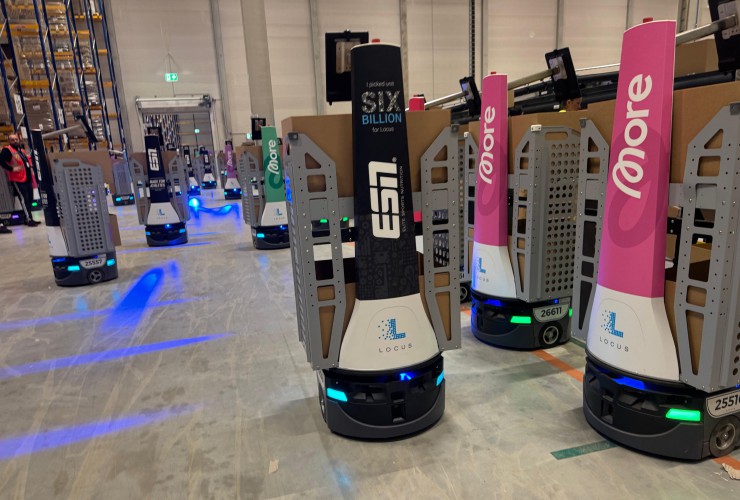
Locus Robotics hat die LocusONE-Plattform mit einer Flotte von Locus Origin AMRs ausgerollt. LocusONE ist an das Logistics Reply WMS von TQG angebunden und orchestriert Roboter und Mitarbeitende in Echtzeit über mehrere Hallen und Pick-Zonen hinweg. Das System folgt zwei Prinzipien: erstens software-getriebene Orchestrierung, die Arbeit sofort neu verteilen kann, wenn Kampagnen die Nachfrage verschieben; zweitens skalierbare Robotikkapazität, die mit dem Bedarf wächst, statt eine einmalige Überdimensionierung zu erzwingen.
Stufenweiser Ramp-up bis zur Vollskalierung
Der Rollout folgte einem bewusst gestuften Ramp-up, der das Wachstum von TQG und den Aufbau der neuen Anlage spiegelte.
- Phase 1: Go-live mit rund 40 Robotern in einer temporären Paletten-Pick-Zone, während die finale Infrastruktur noch aufgebaut wurde. So konnte TQG sofort aus Elsdorf heraus versenden.
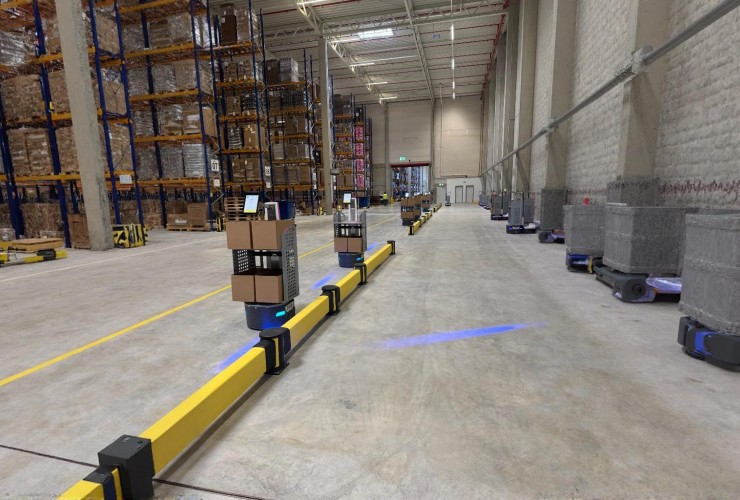
- Phase 2: Erweiterung in das Hochregallager und Ausbau der Flotte auf über 100 Roboter. LocusONE nahm Layout-Änderungen über Konfiguration auf, ohne strukturelles Redesign.
- Phase 3: Einbindung der zweiten und dritten Halle sowie Rollout von FastPick-Zonen für Hochgeschwindigkeits-SKUs, mit weiterer Flottenskalierung zur Unterstützung steigender Volumina.
- Phase 4: Vollskalierung mit rund 350 Robotern über drei verbundene Hallen, erreicht in weniger als acht Monaten nach dem ersten Go-live. Der Standort läuft heute mit Peak-Tageskapazität bei abgestimmten Pick-, Pack-, Fördertechnik- und Outbound-Prozessen.
Dieser stufenweise Ansatz ist ein zentrales Innovationselement. Statt TQG in einen starren Automations-Zeitplan zu drücken, wuchsen Robotikkapazität und Orchestrierung genau dann, wenn die Nachfrage es erforderte.
FastPick für rotierende Fast Mover
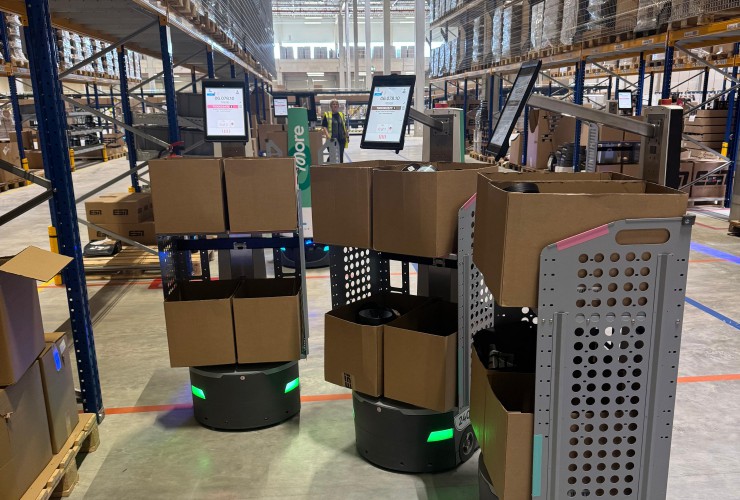
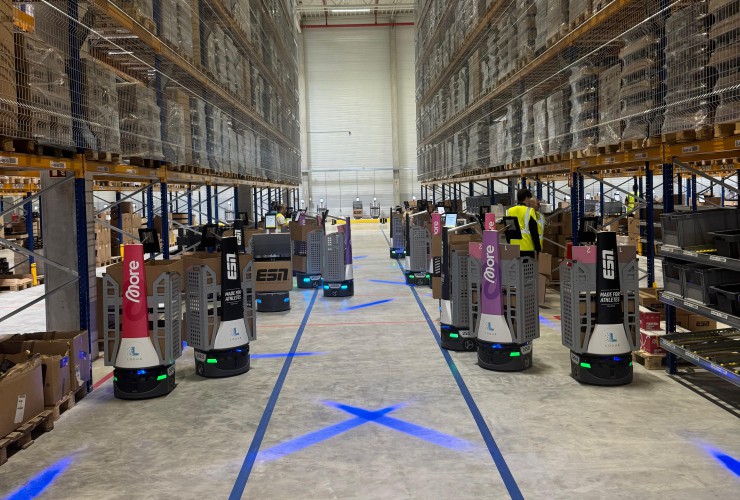
Ein zentrales Element der Lösung ist LocusONE FastPick. TQG nutzt dedizierte FastPick-Zonen in breiten Gängen bzw. Gravity-Rack-Bereichen, in denen Bots bedarfsabhängig zu Pick-Walls clustern. Diese Zonen sind gezielt für SKU-Volatilität ausgelegt. Wenn Kampagnen wechseln und neue Produkte zu A-Movern werden, slotet TQG diese SKUs in die FastPick-Zone um und LocusONE konzentriert automatisch Roboter und Arbeit auf den neuen Nachfrage-Peak. Falls ein Umslotten nicht rechtzeitig möglich ist, bleibt die Performance dennoch stabil: LocusONE kann auch in Standardzonen eine Pick-Wall bilden und Bots dynamisch dorthin ziehen, wo der neue Fast Mover liegt, sodass der Durchsatz gesichert ist, bevor das Layout physisch angepasst wird. Paletten werden von hinten über dedizierte Nachschublanes replenished, wodurch Hochgeschwindigkeits-Picking ohne Decanting in fixe Systeme möglich bleibt. So erreicht TQG sehr hohen Durchsatz bei Fast Movern, während die Platzierung voll flexibel bleibt.
Integrationen und Prozessfluss
Das Locus-System läuft parallel zur übrigen Automationslandschaft in Elsdorf, einschließlich Vanderlande-Fördertechnik und Ranpak-On-Demand-Packaging. Die Roboter speisen gepickte Aufträge in den Downstream-Flow ein, während Fördertechnik und Verpackung Transport, Kartonerstellung und finale Paketverarbeitung übernehmen. LocusONE liefert Echtzeit-Transparenz und Workload-Balancing über die Pick-Zonen hinweg.
Kundennutzen
Die integrierte Lösung liefert klare Ergebnisse entlang der Ziele von TQG.
- Durchsatz auf Niveau fixer Automatisierung bei erhaltener Flexibilität. FastPick-Bereiche ermöglichen Goods-to-Person-Produktivität bei Hochgeschwindigkeits-SKUs ohne Decanting oder starre Infrastruktur. TQG erreicht High-Density-Picking mit minimalem Laufen und konstantem Bot-Zulauf an den Stationen.
- Sofortige Anpassung an Nachfragewechsel. LocusONE verteilt Roboter und Tasks in Echtzeit neu, sodass jede SKU, die zum Fast Mover wird, unmittelbar aufgefangen wird, ohne Hardware umzubauen.
- Peak-Resilienz durch skalierbare Robotik. Die Flotte wuchs in acht Monaten von 40 auf 350 Roboter, inklusive temporärer Peak-Bots während Kampagnen (30 zusätzliche Bots für Black Week). Das reduziert große Arbeitsspitzen und vermeidet Überdimensionierung fixer Automatisierung.
- Schneller Time-to-Value. Der Standort ging weniger als 90 Tage nach Vertragsabschluss live und erreichte die volle Drei-Hallen-Skalierung deutlich früher als geplant.
- Bessere Ergonomie und schneller Ramp-up neuer Mitarbeitender. Laufen ist in FastPick-Zonen weitgehend eliminiert. Picker bleiben im Flow, und neue Mitarbeitende erreichen schnell Produktivität, was für ein stark wachsendes Team entscheidend ist.
- Risikoreduzierte Investition. Das RaaS-Modell erlaubt kontinuierliche Skalierung ohne große Vorab-CAPEX-Wette. Wenn sich das Geschäft entwickelt, können Zonen und Flüsse softwareseitig neu konfiguriert werden.
Kerndaten
Standort: Elsdorf, Deutschland.
Fläche: 40.000 m² mit Erweiterungsoption.
Lagerung: Hochregal und Palettendichte für Fast-Mover-Rotation ausgelegt.
Roboter: ca. 40 beim ersten Go-live, ca. 350 in Vollskalierung.
Kapazität: ausgelegt für 45.000 Bestellungen/Tag und 300.000 Einheiten/Tag zum Start, Skalierung auf 60.000 Bestellungen/Tag und darüber hinaus im Peak.
Integrationen: Logistics Reply WMS, Vanderlande-Fördertechnik, Ranpak-Packaging, mit LocusONE-Orchestrierung und FastPick-Zonen.
Fazit und Ausblick
Das Projekt zeigt, warum flexible, software-definierte Lagerautomatisierung perfekt zu heutigen, promotionsgetriebenen E-Commerce-Modellen passt. Bei TQG liefert LocusONE den Durchsatz, der klassisch mit fixer G2P-Automatisierung verbunden ist, bleibt dabei aber vollständig anpassbar an rotierende Fast Mover, häufige Kampagnen-Peaks und schnelles Wachstum. Der Ramp-up zur größten Locus-Flotte Europas in weniger als acht Monaten macht Elsdorf zu einer Benchmark-Referenz für Hochleistungsautomatisierung ohne Flexibilitätsverlust.
Über die aktuelle Origin-basierte Pick-Operation hinaus eröffnet der Wachstumspfad von TQG bereits die nächsten Use Cases. Der B2B-Kanal gewinnt an Bedeutung, und gemeinsam evaluieren wir Locus Vector als ergänzenden Robotertyp für schwerere Transport- und Replenishment-Flows im Wholesale-Umfeld. Parallel prüft TQG Locus Array, die nächste Evolutionsstufe der Origin-Plattform, als zukünftige Option für noch höhere Dichte und KI-gestützte Aufgabenautomatisierung, während Volumen und SKU-Komplexität weiter steigen.
Das Robotics-as-a-Service-Modell ist der zentrale Enabler dieser Roadmap. Es erlaubt TQG, Flottengröße und Robotertypen über die Zeit flexibel zu steuern, ohne fixes Kapitalrisiko oder Bindung an eine einzige Automationsarchitektur. Kapazität kann mit Kampagnenintensität, Channel-Mix und SKU-Geschwindigkeit wachsen oder sinken, während die Orchestrierungsschicht konstant bleibt. So bleibt die Operation bereit für jedes künftige Nachfragemuster und unterstützt TQG dabei, eine Fulfillment-Engine aufzubauen, die in eine Zukunft skaliert, die sich nicht vorhersagen lässt.
Video: http://tinyurl.com/4yswev48
LocusONE at The Quality Group
Locus Robotics
IFOY category
Integrated Customer Solution
Summary
From Greenfield to Peak-Ready in Eight Months: LocusONE orchestrates up to 350 Locus Origin AMRs at The Quality Group’s 40,000 m² Elsdorf fulfilment centre. Serving the fast growing brands ESN and More Nutrition, whose influencer led campaigns can turn any SKU into a top seller overnight, the LocusONE platform adapts instantly. Tasks and robots are reallocated in real time to follow demand, keeping throughput high no matter which products surge. The operation scaled from 40 to 350 robots in only eight months, proving that flexible, software defined automation has reached fixed automation throughput while preserving the adaptability today’s e commerce business models require.
Customer
The Quality Group
Realisation Phase
From: 2025-01-06
To: 2025-10-31
Investment
300000 €
Case Study
The Quality Group (TQG) is one of Germany’s fastest growing e commerce companies in functional food and sports nutrition. Through its brands ESN and More Nutrition, TQG combines premium, locally produced products in Germany with a highly digital, influencer driven go to market model. Frequent product launches, limited drops and weekly promotions create short, intense peaks and rapidly shifting demand patterns. This means SKU velocity is not stable. Any product can become an overnight fast mover, and the set of A movers changes repeatedly throughout the months.
Initial situation and project objectives
TQG built a new 40,000 m² greenfield fulfilment centre in Elsdorf to support its rapid growth and to consolidate its network. Two previously separate warehouse operations were migrated into Elsdorf, allowing TQG to centralize fulfilment, simplify flows, and free up the former main site to be transformed into a second production location. The Elsdorf facility was designed to start at roughly 45,000 e commerce orders per day and 300,000 units per day, and to scale quickly to 60,000 orders per day and beyond during peak seasons. The key requirement was to create a fulfilment operation that could deliver goods to person level throughput without locking the business into rigid fixed automation and high capital investments. In other words, TQG needed maximum performance with the flexibility to change flows, zones, and fast mover placement as campaigns and product trends shift, while keeping automation investment lightweight and primarily OPEX based.
The challenges
The project was shaped by four realities of TQG’s business model and network strategy.
- First, volatility is structural. Influencer campaigns and drops create massive demand spikes on a small, rotating subset of SKUs. The operation must follow demand immediately.
- Second, peak periods are frequent, not seasonal only. Events such as ESN Week and Black Week require step changes in capacity several times per year.
- Third, Elsdorf was not an “add on” site. It replaced two existing warehouse operations, and TQG needed to shut down the former main location on a defined timeline to repurpose it into a second production site. That created a hard requirement to ramp the new building to meaningful scale quickly, without waiting for a long automation build out.
- Fourth, any fixed AS/RS or goods to person automation would have required decanting products from inbound pallets into totes or bins before storage and picking. That extra handling step adds time, labor, and complexity, and it breaks down completely when fast movers rotate constantly. For TQG, decanting inventory (repacking of goods – usually from the original packaging into another transport unit) just to pick it again shortly after is wasted effort and the opposite of what their business needs: maximum throughput with zero loss of flexibility.
The solution
Locus Robotics deployed the LocusONE platform with a fleet of Locus Origin AMRs. LocusONE integrates with TQG’s Logistics Reply WMS and orchestrates robots and workers in real time across multiple halls and picking zones. The system was designed around two principles: first, software driven orchestration that can reallocate work instantly as campaigns shift; second, scalable robotics capacity that can grow with demand rather than forcing a one time overbuild.
Staged ramp up to full scale
The deployment followed a deliberate staged ramp that mirrors TQG’s growth and the build out of the new facility.
- Phase 1: Go live with about 40 robots in a temporary pallet pick zone while the final infrastructure was still being installed. This allowed TQG to start fulfilling orders from Elsdorf immediately.
- Phase 2: Expansion into high bay racking, growing the fleet to more than 100 robots. LocusONE absorbed layout changes through configuration rather than structural redesign.
- Phase 3: Integration of a second and third hall and rollout of FastPick zones for high velocity SKUs, with the fleet scaling further to support rising order volume.
- Phase 4: Full scale operation with around 350 robots across three connected halls, achieved in under eight months from initial go live. The site is now running at peak daily capacity with fully synchronized picking, packing, conveyance and outbound flows.
This staged approach is a core innovation element. Instead of forcing TQG into a fixed automation build timeline, robotics capacity and orchestration scaled exactly when demand required it.
FastPick for rotating fast movers
A central feature of the solution is LocusONE FastPick. TQG uses dedicated wide aisle or gravity rack FastPick zones where bots cluster on demand to form pick walls. These zones are intentionally designed for SKU volatility. As campaigns change and different products become A movers, TQG can reslot those SKUs into the FastPick area and LocusONE automatically concentrates robots and work on that demand peak. If reslotting cannot happen in time, the system still performs: LocusONE can create a pick wall in standard zones as well, dynamically pulling bots to wherever the new fast mover sits so throughput is protected even before the physical layout is adjusted. Pallets are replenished from the back through dedicated lanes, keeping high velocity picking flowing without decanting into fixed systems. This allows TQG to reach extremely high throughput on fast movers while keeping placement fully adaptable.
Integrations and operational flow
The Locus system operates alongside the wider Elsdorf automation set up, including Vanderlande conveyance and Ranpak on demand packaging. Robots feed picked orders into the downstream flow, while conveyors and packaging systems handle transport, carton creation and final parcel processing. LocusONE provides real time visibility and workload balancing across pick zones.
Customer benefits
The integrated solution delivers clear outcomes aligned to TQG’s objectives.
- Throughput comparable to fixed automation, with flexibility preserved. FastPick areas enable goods to person level productivity on high velocity SKUs without decanting or rigid infrastructure. TQG achieves high density picking with minimal walking and constant bot arrival at stations.
- Instant adaptability to demand shifts. LocusONE reallocates robots and tasks in real time, so whichever SKU becomes a fast mover can be absorbed immediately without changing hardware.
- Peak resilience through scalable robotics. The fleet ramped from 40 to 350 robots in eight months, including the ability to add temporary peak bots during campaigns (30 additional bots for Black Week). This removes the need for large labour spikes or over dimensioned fixed automation.
- Faster time to value. The site went live in under 90 days from signature and reached full three hall scale far ahead of the original roadmap.
- Improved ergonomics and ramp training. Walking is largely eliminated in FastPick zones. Pickers remain focused and productive, and new associates reach competency quickly, which is critical for a fast growing workforce.
- Risk reduced investment. The RaaS model enables continuous scaling without a large upfront CAPEX bet. As the business evolves, zones and flows can be reconfigured in software.
Key data
Location: Elsdorf, Germany.
Site size: 40,000 m² with expansion capability.
Storage: high bay racking and pallet density designed for fast mover rotation.
Robots: about 40 at first go live, about 350 at full scale.
Capacity: designed for 45,000 orders per day and 300,000 units per day at launch, scaling to 60,000 orders per day and beyond in peak.
Integrations: Logistics Reply WMS, Vanderlande conveyance, Ranpak packaging, with full LocusONE orchestration and FastPick zones.
Conclusion and Outlook
This project demonstrates why flexible, software defined warehouse automation is a perfect match for today’s promotion driven e commerce environment. At The Quality Group, LocusONE delivers the throughput traditionally associated with fixed G2P automation while staying fully adaptable to rotating fast movers, frequent campaign peaks and rapid business growth. The scaled ramp to Europe’s largest Locus fleet in under eight months makes Elsdorf a benchmark reference for high performance automation without sacrificing flexibility.
Beyond the current origin based picking operation, TQG’s growth trajectory is already opening the next use cases. The B2B channel is increasing in importance, and together we are evaluating Locus Vector as a complementary robot type for heavier transport and replenishment flows connected to wholesale shipments. In parallel, TQG is also reviewing Locus Array, the next evolution of the Origin platform, as a future option for even higher density and AI driven task automation as volumes and SKU complexity continue to rise.
The robotics as a service model is a key enabler for this roadmap. It allows TQG to flex fleet size and robot types over time without taking on fixed capital risk or committing to a single automation architecture. Capacity can expand or contract with campaign intensity, channel mix, and product velocity, while the orchestration layer stays constant. This keeps the operation ready for whatever demand pattern emerges next and supports TQG’s goal to build a fulfilment engine that can scale into a future that cannot be predicted in advance.
Video: http://tinyurl.com/4yswev48